Instrument technique marks
F3 9 marks bowing, harmonics and the snap pizzicato, F3 W the brass player's stopped +, open circle and half-stopped sign and the hi-hat's half-open sign, F4 J jazz scoops, rips, doits and falls, and F3 G guitar techniques on the TAB staff, with the damping sign on a guitar.
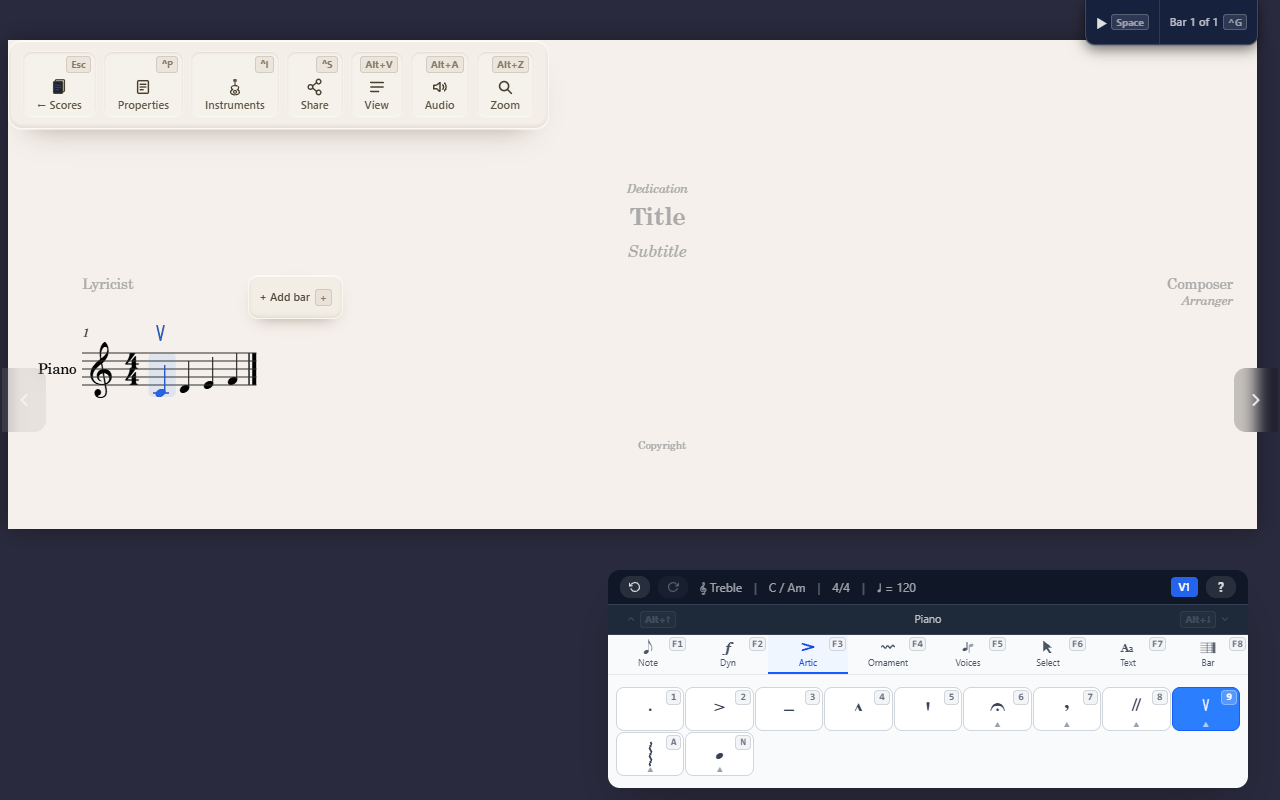
Instrument-specific marks live in four clusters: F3 9 for bowed
instruments, F3 W for brass, wind and the hi-hat, F4 J for jazz, and
F3 G for fretted instruments only.
Bow and string marks
F3 9 marks Up-bow (1), Down-bow (2), Harmonic (3) or Snap
pizzicato (4) on the selected note. These apply to any note regardless of
instrument — nothing stops you marking a bowing on a piano part, so use them
where they’re musically appropriate.
A snap pizzicato, the Bartók pizzicato sign, stands above the staff; Flip
(X) moves it below, turned upside down. It plays louder and short: a
violin, viola, cello or double bass plays the note pizzicato, and a harp
keeps its own sound (see A harp’s plucking signs).
A harmonic is a small circle over its note, and each note of a chord has
its own: on a chord, Harmonic marks the note the cursor is on, and with a
selection, every note in it. A chord’s circles stack above it, each over
its own notehead. Pressing 3 again takes the circle off; the button is
lit while the note the cursor is on has one.
On a harp a harmonic is written at the string the harpist plucks, and it plays an octave higher, as it sounds. On any other instrument the note plays as written.
A harmonic at the twelfth or seventeenth is written as a chord: the string with its circle, and the sounding pitch as a small note in brackets on the same stem (see Small notes). On a harp that chord plays the small note, in place of the string.
A guitar’s harmonic is more often written at the fingered pitches, a diamond for the node, with its sounding pitch in brackets after them: see Sounding pitch in Using different notehead shapes.
On a violin, viola, cello or double bass, harmonics play at the pitch they
sound. An artificial harmonic, the stopped note with the node above it as a
diamond on the same stem, plays the harmonic the two make: two octaves
above the stopped note when the diamond is a fourth above it, an octave and
a fifth for a fifth, two octaves and a major third for a major third, and
two octaves and a fifth for a minor third. A diamond on its own plays the
harmonic it makes on its string, so name the string: a string number (see
String numbers on bowed strings in Articulations),
words such as II or sul D over it, the dotted line running on from either,
or the open string as a small bracketed note on the diamond’s stem (S and
B in the Noteheads menu). That small open-string note is drawn black
whatever its value. A diamond with no string named plays as written, and a
sounding pitch you write always wins. On these instruments the technique
words harmonics and art. harm. move no note up an octave: a note with its
harmonic circle is written at its sounding pitch and plays as written.
Wind, brass and hi-hat signs
F3 W marks Stopped (1), Open (2), Half-stopped (3) or Half-open
(4) on the selected note. The + marks a horn’s hand-stopped note and the
circle the open note after it; with a harmon or plunger mute the two show
the hand covering and uncovering the mute; the + also marks a woodwind key
slap. On a hi-hat the + is closed, the circle open, and Half-open, a
circle crossed by a stroke, half open, and each plays that way (see
Percussion and drum kit notation). A note takes one of the four:
setting another replaces it, and setting the same one again removes it.
They stand above the staff, centred over the note, outside its stem or
beam; X moves them below with the note’s other articulations. A stopped
note plays softer and a little shorter, as the word stopped does; a
half-stopped note plays a little softer. A hi-hat’s sign changes its sound
instead.
To show a gradual change from one to the other, write the signs as technique text: the Technique dialog has + and circle buttons, and its Line and End rows draw an arrow from one sign to the next (see Adding technique text).
Jazz signs
F4 J opens the jazz signs, which swoop onto a note or fall off it. Onto
the note: Scoop, Plop and Rip. Off it: Doit, Fall and Wavy fall. The top
row of the submenu, 1 to 6, holds Scoop, Plop and the short Rip,
Doit, Fall and Wavy fall; the medium ones are on E R T Y and
the long ones on D F G H, each drawn at its length with its
length named under it.
A fourth row holds a straight Doit (V) and a straight Fall (B): a
straight line rising or falling off the note into nothing. A string player
reads it as a glissando with no finishing pitch, which a plucked note often
takes, since its sound dies away before it would arrive. It is as wide as
the medium doit and plays as the medium doit or fall does. A glissando’s
own line, from the Glissando menu, runs between two notes.
A note takes one sign onto it and one off it: a new one replaces the one there, and setting the same one again removes it. The sign stands before the note’s accidental or after its dots, and the bar makes room for it. On a chord it is drawn once: a scoop or rip into the lowest note, a plop into the highest, a doit off the highest, a fall off the lowest. Each plays as a quick slide onto or off the note; an exported MIDI file plays the note without it. A sign stands outside a note’s ledger lines.
Guitar techniques
F3 G marks Bend (full/½/¼), Slide (up/down), Let ring, Palm mute, or
Vibrato — eight techniques specific to fretted instruments. They only
appear as available when the current part is a fretted instrument (has a
tuning set), and only actually render on that instrument’s TAB staff
— never on the standard notation staff. A guitar technique also needs the
note to already have a string/fret assignment; on a note with no fret
assigned yet, applying one silently has no visible effect.
9 in the same submenu sets the harp’s damping sign ⊕ on the note: the
strings are damped where the note ends (at a rest, where it starts). It
stands above the standard notation staff and stops every string left
ringing under l.v. sempre. Setting it again removes it.
Hammer-ons and pull-offs aren’t a separate mark here — notate them with a regular slur (see Adding slurs). On the TAB staff the slur is marked H or P; on the standard notation staff it is a slur alone.
Tips
- Not seeing the Guitar submenu light up? Confirm the current part is a fretted instrument (Instruments panel → tuning set).