Using the sustain pedal
F7 P writes a piano's pedals beneath its lowest staff — the sustain pedal in three styles, the sostenuto, the una corda, half pedalling and gradual changes.
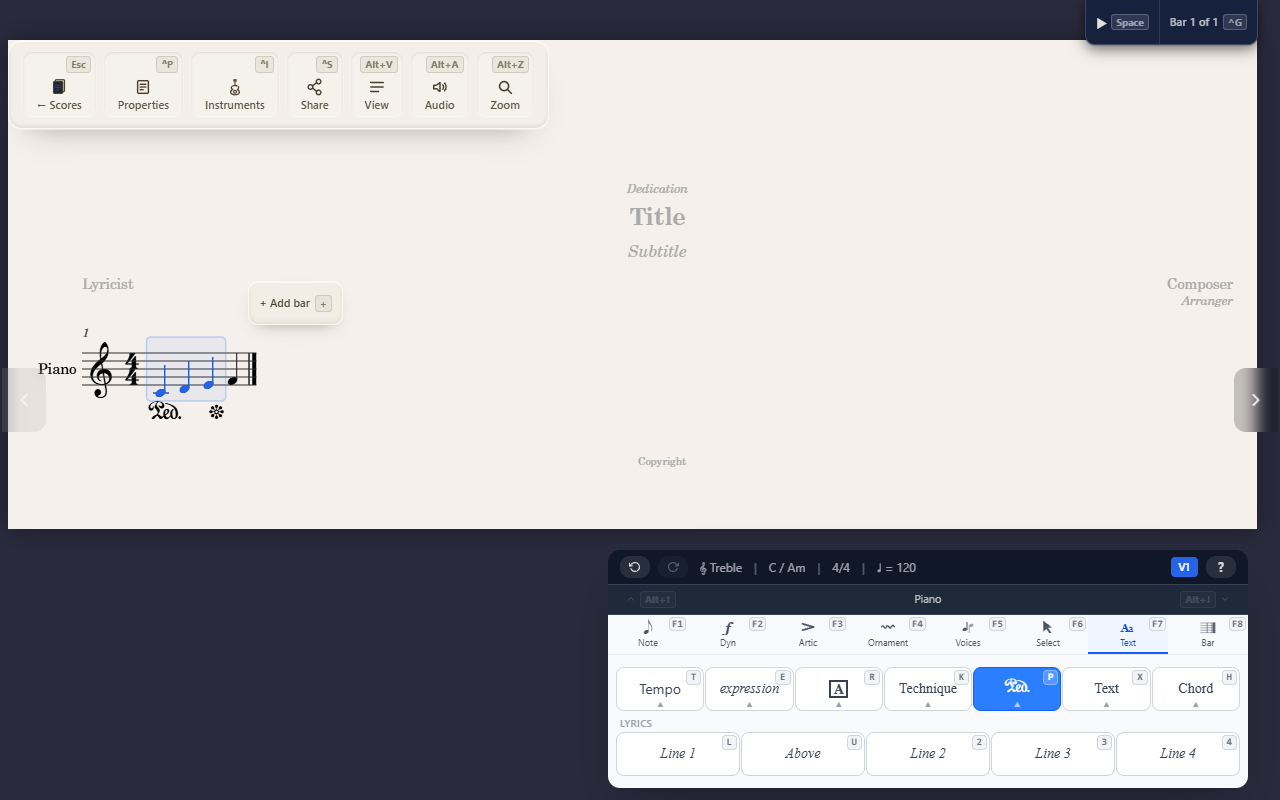
A pedal marking is a spanner, stretching across the passage the pedal is held down for — see Lines between notes for the shared mechanic (a range already selected applies it immediately, end to end; a single note lets you pick the end point).
The pedal submenu
F7 P opens the pedal submenu:
1— Text: the traditionalPed.…*.2— Bracket: a bracket under the notes, from where the pedal goes down to where it comes up.3— Mixed:Ped.in upright letters, with a line to its release.4— Sostenuto:Sost. Ped.with a line.5— Una corda: una corda with a line, or u.c. over a short passage.6— Half pedal:½ Ped.with a line, the sustain pedal held half down.0— changes under a pedal (see Half and gradual pedalling below).
1, 2, 3 and 6 are the sustain pedal. The three styles mean the
same pedal, so pick the one that matches the rest of your score.
Where pedals go
A piano’s pedals stand beneath its lowest staff, whichever staff the cursor is on when you write one, and a selection across both staves takes one pedal, from its first note to its last. Each pedal goes down and comes up under its own notes, and stands as close to the staff as the notes above it allow. Where pedals overlap, the sustain pedal is nearest the staff, then the sostenuto, then the una corda.
A pedal still held at the start of a new line repeats its sign there in brackets — (Ped.), (Sost. Ped.), (u.c.) — with its line running on. A Bracket pedal’s line runs on by itself.
Changing the pedal
A pedal that starts on the note where the one before it ends is a change:
the pedal comes up and goes straight back down at that note. Drawn with a
line, the change is a notch in the line, its point over the note. In the
Text style it is * and Ped. again.
Half and gradual pedalling
Under a pedal drawn with a line, 0 opens its changes for the note at the
cursor:
F— Fully down: the line steps down at the note.H— Back to half: the line steps back up to half down.R— Half lift: from fully down, the pedal lifts halfway and goes straight back down, a small notch marked (½).G— Gradual: a diagonal line. On the note a pedal goes down on, it goes down gradually; on its last note, it comes up gradually; on a change, the change is gradual.
On the note a pedal goes down on, H starts it half down and F fully
down. F, H and R are for the sustain pedal; G works on any pedal
drawn with a line. Each change is greyed where it would do nothing on the
note at the cursor, and lit where it’s set; press it again to take it off.
Playback
The sustain pedal holds the notes struck under it, and those still sounding when it goes down, until it comes up or changes. The sostenuto holds only the notes sounding as it goes down, not those struck after it. Notes under the una corda play softer. Half and gradual pedalling play as the sustain pedal fully down. An exported MIDI file carries each pedal as its MIDI controller, a half pedal at half depth and a gradual change in steps.
Tips
- The words una corda and tre corde, written as technique text
(
F7 K), make the notes after them softer and back again, with no line — see Adding technique text. - MusicXML has no una corda pedal: it goes out as its words with a line, which QuickStave reads back as the pedal.