A harp's plucking signs
On a harp, F3 H writes the nail and plectrum signs, alone or with a bracket over several notes, and the pedal buzz; F3 9 4 writes the snap pizzicato.
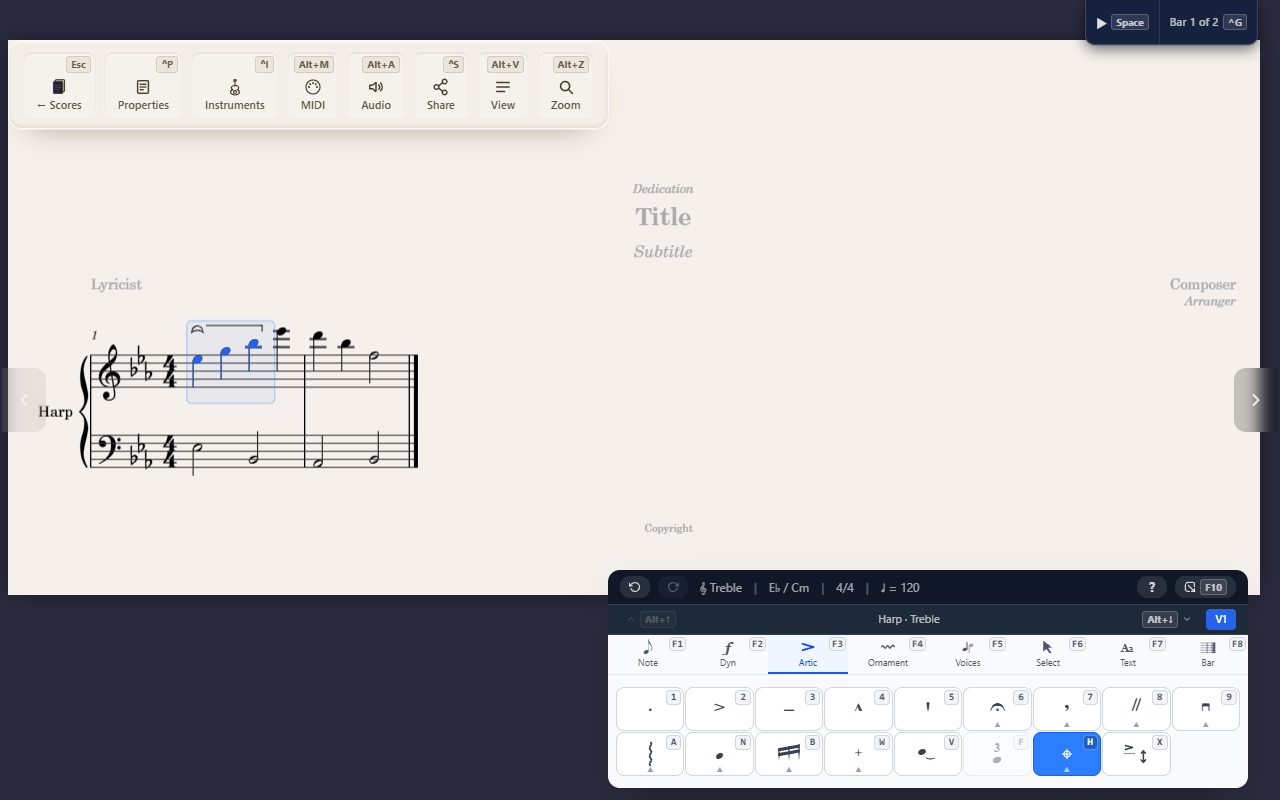
A harp’s string can be plucked with the fingernail or a plectrum, slapped against the soundboard, or made to buzz against its pedal. QuickStave writes each with its sign.
The nail and the plectrum
On a harp, the Articulations tab’s Harp signs button (F3 H) holds the
two signs after its damping signs:
4— Nail: the nail sign over the note at the cursor, or over each note of a selection.5— Nail with bracket: the sign with a bracket over several notes.6— Plectrum: the plectrum sign over the note, or over each selected note.7— Plectrum with bracket.
A note without a sign is plucked normally. Choose the same sign again to take it off; the other sign replaces it.
A bracket works as any spanner does. With notes selected, the sign goes over the first and the bracket over them all. Without a selection, spanner mode opens at the note: move on and end it at the last note the sign is for, or end it on the note itself for a short bracket over that one note. Choose the bracket again on its first note to take it off, or the other sign’s bracket to change its sign.
The sign stands above the staff, centred over its note. A bracket’s line
runs from the sign, level with its top, to just past the last note, and ends
in a short hook toward the staff; the sign and the line keep clear of every
note under them. On a new system the line runs on from the start of the
first bar. Flip (X) moves a sign or a bracket below the staff, where the
nail sign is turned upside down and the hook turns up.
A plectrum sign without a bracket lasts until you write ord., nat. or
norm. (Technique, F7 K).
The pedal buzz
8, Pedal buzz, makes the note buzz: its pedal is held between two
notches as the string is plucked. The note’s other setting is drawn beside
it, a head without a stem with its own accidental for each of its notes,
joined to the note’s stem by a line, and the buzz sign stands below between
them. The other setting is the next notch up: a D♭ buzzes with D♮, a D♮
with D♯. A D♯ has no notch above it, so it buzzes with D♮; spell the note
for the pair you want. A single note takes the one-string sign, a chord the
other. Explain the sign the first time it appears, with the words
pedal buzz.
Snap pizzicato
On any instrument, Bowing (F3 9) then 4 writes a snap pizzicato, the
Bartók pizzicato sign, above the staff; Flip (X) moves it below, turned
upside down. On a harp’s lower staff it stands between the staves.
Words
The Technique dialog (F7 K) lists a harp’s playing instructions under
Plucked Strings:
- près de la table, p.d.l.t. or table — pluck near the soundboard; près des chevilles or p.c. — near the pegs.
- con le unghie or unghia — with the fingernails, in words.
- gliss. — slide along the strings of a written-out scale; non gliss. — pluck each string.
- sempre arpeggiando or arpeggiando — roll the chords; sempre non arpeggiando or non arpeggiando — play them at once.
- pedal buzz — the words that explain the buzz sign.
- with fingertips or tap, with knuckles or knock, with palm or slap — sounds on the body of the harp.
- ord., nat. or norm. — back to normal.
sons étouffés is there too (see Damping a harp’s strings).
Playback
A snap pizzicato is played louder and short. A harp keeps its own sound; a violin, viola, cello or double bass plays the note pizzicato. The nail, the plectrum and the pedal buzz play the written note as normal: QuickStave’s harp has no sound for them.
Under gliss. each string rings on, as a slide leaves it, until it’s plucked again or non gliss., ord., damp or a damping sign damps it. The arpeggiando words roll chords or play them at once. Where to pluck, the nails and the sounds on the body play the written notes. ord., nat. or norm. ends every technique before it.
Tips
- MusicXML keeps the signs: the nail as
fingernails, the snap pizzicato assnap-pizzicato, the plectrum and the pedal buzz by their sign’s name, and a bracket as a bracket from its sign.