Trill lines and octave-shift lines
A trill line and an octave-shift line both use the same select-then-shortcut spanner mechanic as slurs and hairpins, stretching across a passage rather than sitting on one note.
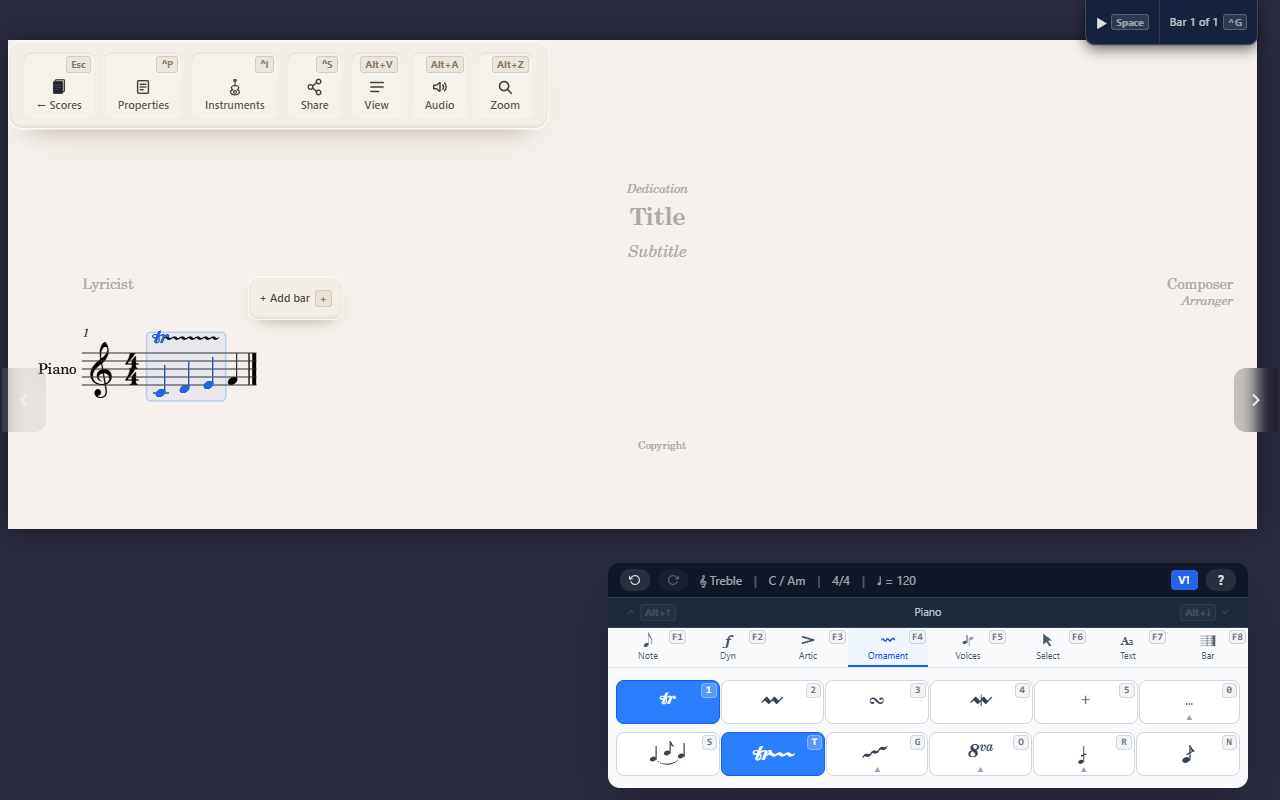
A trill line and an octave-shift line are both spanners — they stretch across a passage rather than sitting on a single note. See Creating spanners for the shared mechanic: a range already selected creates one immediately, end to end; a single note selected lets you pick the end point with a live preview.
Trill line (F4 T)
Draws a wavy line across the selected passage. If the start note doesn’t already have a trill symbol, adding the line stamps one there automatically — see Turns, mordents, and trills for that symbol on its own.
Octave-shift lines (F4 O 1–4)
8va, 8vb, 15ma, and 15mb shift a passage’s sounding octave without touching the notation itself — the notes stay exactly where they’re drawn on the staff; only what’s actually heard on playback moves up or down an octave (8va/8vb) or two octaves (15ma/15mb) for as long as the line lasts.
Tips
- These share their mechanic with hairpins, slurs, and pedal lines — see Creating spanners rather than re-learning it per mark.