Damping a harp's strings
On a harp, F3 H writes the damping sign for one hand or both hands, and the Technique dialog's words let the strings ring or damp them.
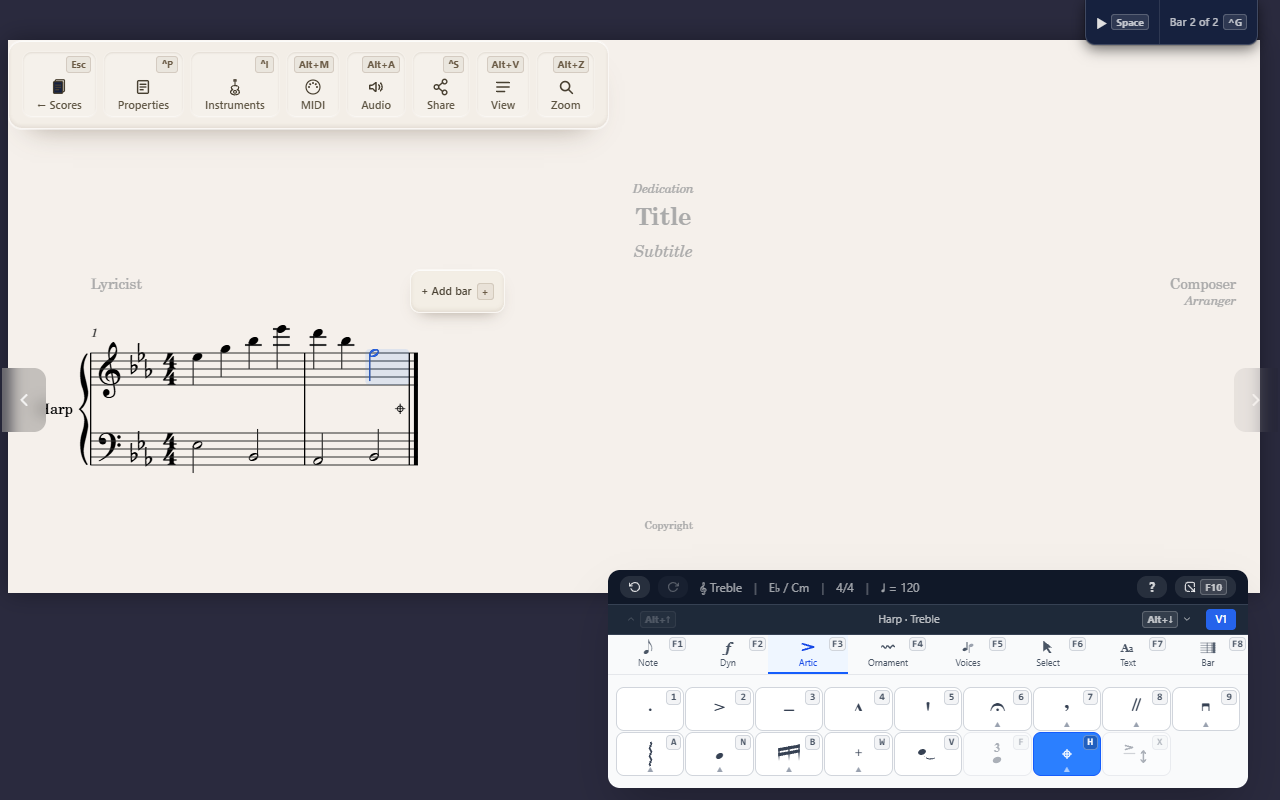
A harp’s strings ring on after they’re plucked until the harpist damps them. QuickStave writes the damping sign ⊕ where the strings are damped, and plays the words that leave them ringing.
The damping sign
On a harp, the Articulations tab’s Harp signs button (F3 H) opens the
damping signs first:
1— Damp, this hand: one sign for the hand on the cursor’s staff.2— Damp, both hands: one sign between the staves.3— Damp, on the stem: the sign on a small note’s stem (see below).
Its choices 4 to 8 are the plucking signs, the nail, the plectrum and
the pedal buzz: see A harp’s plucking signs.
On a note, the sign goes after it, where the note ends. On a rest, it goes where the rest starts, so a sign on a bar’s first rest stands just after the barline; an empty bar takes one too. Choose the same again to take the sign off; the other choice replaces it. Clicking a sign in the score opens Harp signs at its note or rest.
Damping particular strings
To damp some strings and leave the others ringing, write the strings to
damp as small notes (F3 N S, see Small notes), usually in
a second voice with their stems the other way from the played notes, and
put the sign on their stems with 3, Damp, on the stem. The small notes
can have note values, to show the rhythm of the damping, or stand on their
own where the damping falls, with the second voice’s rests hidden (Del on
a rest). 3 is greyed unless the note at the cursor is small.
The sign stands near the end of the stem, inside any beam. A small chord with the sign is drawn as a group of strings damped together: its notes spread out, rising from left to right, joined by a diagonal line, with one stem from the middle of the line carrying the sign.
Where the sign goes
Both hands’ sign stands between the staves, just before what comes next, or just before the barline at the end of a bar.
One hand’s sign stands after the notes it damps, level with them, as close to them as it can be without standing on the staff. Notes high on the staff or above it take the sign above, low notes below. The lower hand’s notes above its staff take it between the staves.
Letting strings ring
The Technique dialog (F7 K) lists her words under Plucked Strings:
- l.v. — the note it stands at rings on.
- l.v. sempre or leave all strings to ring on — every note rings, through the rests.
- damp, secco or damp in all rests — the strings are damped, and l.v. sempre ends. ord. ends it too.
- sons étouffés — each note is damped at once, until ord., nat. or
norm. A staccato wedge on each note (
F3 5) may go with it.
Playback
A harp’s note plays its written length unless it’s left to ring. A note
under l.v. sempre or leave all strings to ring on, a note with l.v. at
it, and a note with an open tie (Let ring, F3 V) ring until their strings
are damped: by a damping sign of their hand or of both hands, by damp,
secco, damp in all rests, sons étouffés or ord., or by the same
string being plucked again. Under sons étouffés each note plays half its
length, with or without its wedge, until ord., nat. or norm. A damping sign under l.v. sempre damps what’s ringing there, and
the notes after it ring again. A sign on a small note’s stem damps only the
strings its notes name; the small notes themselves aren’t played.
Tips
- MusicXML keeps the sign: one hand’s as a damp mark, both hands’ as damp all, and one on a stem as the note’s own pluckedDampOnStem mark.